Cinema Machina Knowledge

What Is Dolby TrueHD, Atmos, DTS-HD MA & DTS:X?

A visual guide to lossless carriers, immersive audio and the playback chain that decides what your room actually receives.

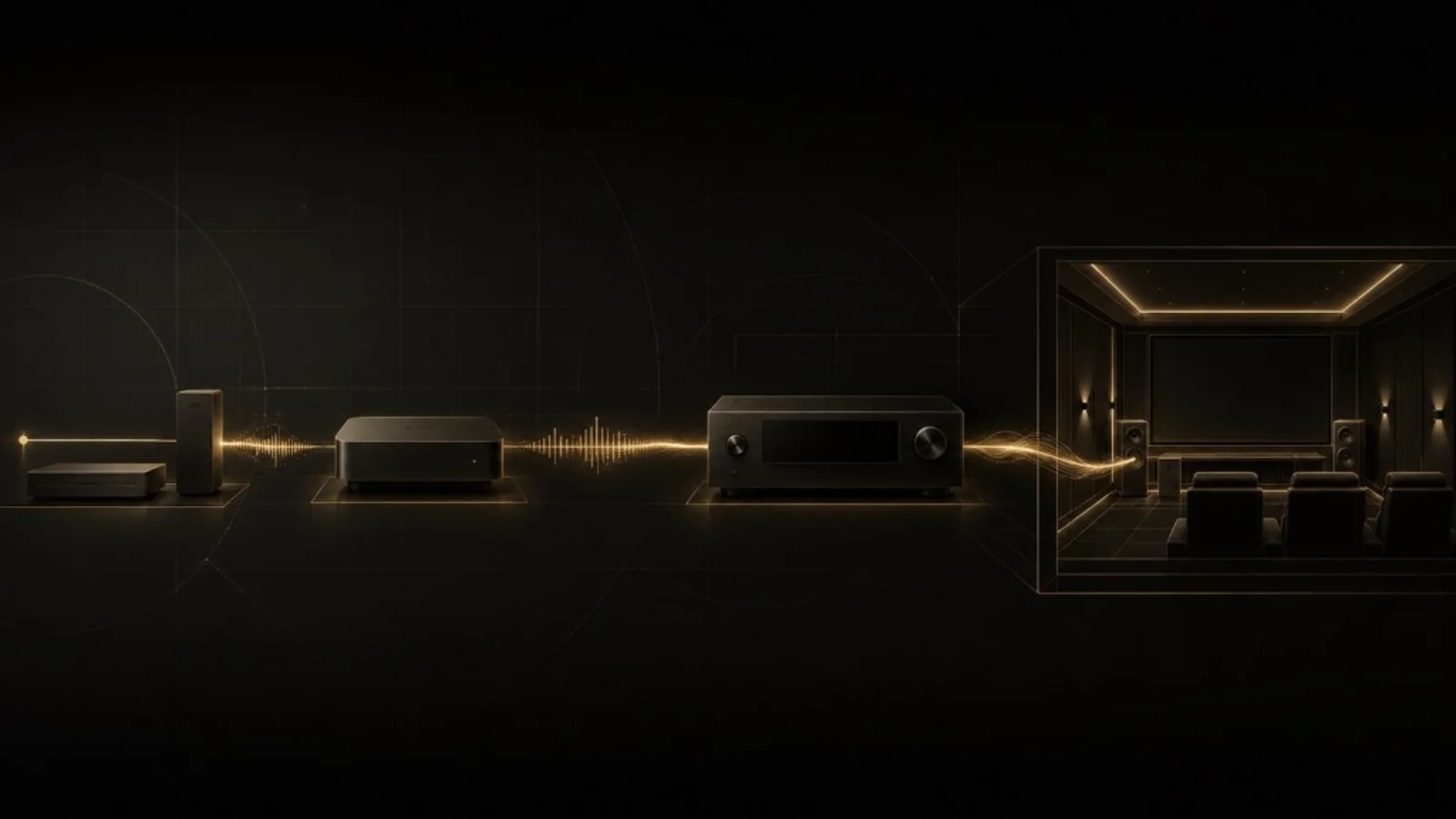
The format stack

  1. Source Disc, file, application or console
  2. Codec or carrier What the audio is encoded as
  3. Immersive information Object data, when the title carries it
  4. HDMI transport Direct HDMI, eARC or ARC
  5. Decoder Where the bitstream becomes audio
  6. Speaker rendering What the room finally hears

Worked examples

  • Blu-ray TrueHD carrier · Atmos objects · AVR decodes
  • Streaming Dolby Digital Plus carrier · Atmos objects
  • Disc (DTS) DTS-HD MA carrier · DTS:X where present
  • Source-decoded Carrier already decoded · multichannel PCM
Format comparison

Six labels. Two families. One question.

Select a format to see how it travels and where it is most often misread.

Formats covered Dolby Atmos Dolby TrueHD DTS:X DTS-HD Master Audio

Dolby TrueHD

Dolby’s lossless codec. Dolby describes it as bit-for-bit identical to the master recording.

Carrier · Dolby TrueHD, losslessImmersive data · Atmos only when the title carries it

Class
Lossless carrier, channel-based on its own
Common source
Blu-ray, UHD Blu-ray, disc-derived files
Typical path
Player bitstream, direct HDMI or a capable eARC link
Equipment needed
A decoder that supports TrueHD and a transport that carries it
AVR may indicate
TrueHD, Dolby TrueHD, or Dolby Atmos when Atmos rides on it
Principal limitation
High bitrate: ARC and some TV passthrough paths cannot carry it
Common misunderstanding
TrueHD does not mean Atmos. A TrueHD track can be 5.1 or 7.1 with no height information at all.

Dolby Atmos

Immersive audio information: bed channels plus objects. It is not a codec, so it always travels inside one.

Carrier · TrueHD on disc, Dolby Digital Plus when streamingImmersive data · Atmos objects and metadata

Class
Object-based; lossless only when its carrier is
Common source
Blu-ray via TrueHD; streaming via Dolby Digital Plus
Typical path
Whatever path its carrier takes
Equipment needed
Content, application, device, transport and an Atmos renderer
AVR may indicate
Dolby Atmos, usually with the carrier named beside it
Principal limitation
Decoding to PCM at the source discards the objects
Common misunderstanding
Atmos is not automatically lossless. The word on the display says nothing about which carrier delivered it.

Dolby Digital Plus + Atmos

The streaming delivery. Dolby states that broadcast and streaming services deliver Atmos using Dolby Digital Plus.

Carrier · Dolby Digital Plus, bandwidth-efficientImmersive data · Atmos objects inside the same stream

Class
Lossy carrier, object-based content
Common source
Streaming applications, broadcast, some downloads
Typical path
Application, then HDMI or eARC to the decoder
Equipment needed
Title, tier, application, device and renderer all supporting it
AVR may indicate
Dolby Atmos alongside DD+ or Dolby Digital Plus
Principal limitation
Compressed carrier, and ARC may not pass it at all
Common misunderstanding
This is genuine Atmos, not a counterfeit. It is simply a compressed carrier rather than a disc-grade one.

DTS-HD Master Audio

The lossless DTS carrier for disc-grade releases. The DTS counterpart to TrueHD, not a version of it.

Carrier · DTS-HD Master Audio, losslessImmersive data · a DTS:X layer only on titles that have one

Class
Lossless carrier, channel-based on its own
Common source
Blu-ray and UHD Blu-ray
Typical path
Player bitstream, direct HDMI or a capable eARC link
Equipment needed
A decoder that supports DTS-HD Master Audio
AVR may indicate
DTS-HD MSTR or DTS-HD Master Audio
Principal limitation
A constrained chain can fall back to the DTS core
Common misunderstanding
“DTS-HD” alone may mean DTS-HD High Resolution, which is a different tier from Master Audio.

DTS:X

The DTS immersive layer. DTS describes it as object-based, built on DTS-HD Master Audio and backward compatible within a single bitstream.

Carrier · the DTS bitstream, commonly DTS-HD MAImmersive data · DTS:X objects

Class
Object-based; lossless when carried by DTS-HD MA
Common source
Blu-ray, UHD Blu-ray, some streaming titles
Typical path
Inside the DTS bitstream, decoded at the AVR
Equipment needed
A DTS:X-capable decoder and a title that includes the layer
AVR may indicate
DTS:X, or DTS-HD MA with Neural:X when it is upmixing instead
Principal limitation
Not every DTS-HD MA release carries a DTS:X layer
Common misunderstanding
DTS:X and DTS-HD Master Audio are related labels, not interchangeable ones.

Multichannel PCM

Audio that has already been decoded and is sent as uncompressed channels.

Carrier · none left: the decode already happenedImmersive data · consumed at the source, not forwarded

Class
Uncompressed, channel-based
Common source
Any device decoding internally; some discs and files carry LPCM
Typical path
Source decodes, then multichannel PCM over HDMI
Equipment needed
Enough transport bandwidth for the channel count
AVR may indicate
Multi In, PCM or Multichannel PCM
Principal limitation
The AVR can no longer render objects itself
Common misunderstanding
PCM is not inherently inferior. A correct decode of a lossless track stays lossless. What is lost is object rendering.
Source and signal path

Where formats live or die.

The codec is chosen at the source. Whether it survives is decided here.

Source

  • Blu-ray / UHD player

    Disc-grade delivery. The release itself may carry TrueHD or DTS-HD Master Audio, with an immersive layer on some titles.

  • Streaming application

    Bandwidth-efficient delivery. Atmos commonly arrives on Dolby Digital Plus, subject to title and tier.

  • Local media file

    Depends on the file and on whether the server hands it over untouched. See Direct Play.

  • Game console or PC

    Governed by system audio settings. Many configurations decode or re-encode before the signal ever leaves.

  • TV application

    Constrained by what the television’s own application supports, which differs from the same app on other hardware.

Signal path

  • Source → AVR → display

    1. Source
    2. AVR
    3. Display
    Transport
    Transport supports this high-bitrate lossless and immersive data
    Decoding
    At the AVR or processor
    Likely failure point
    Player set to decode, or passthrough disabled in the app
  • Source → TV → eARC → AVR

    1. Source
    2. TV
    3. eARC
    4. AVR
    Transport
    Device support still required HDMI states eARC carries high-bitrate formats, but the television must pass them on
    Decoding
    At the AVR, if the television forwards it intact
    Likely failure point
    eARC not enabled, or the television re-encoding or downmixing
  • Source → TV → ARC → AVR

    1. Source
    2. TV
    3. ARC
    4. AVR
    Transport
    Likely fallback HDMI states that ARC cannot pass uncompressed and higher-bandwidth audio
    Decoding
    At the AVR, but from a reduced stream
    Likely failure point
    The return channel itself
  • TV app → eARC → AVR

    1. TV app
    2. eARC
    3. AVR
    Transport
    Device support still required the link can carry immersive audio; the application decides what is produced
    Decoding
    At the AVR, on whatever carrier the app emits
    Likely failure point
    Title, tier or app support on that television
  • Source-decoded PCM → AVR

    1. Source decodes
    2. PCM
    3. AVR
    Transport
    Not available through this path object rendering at the AVR
    Decoding
    At the source, before the cable
    Likely failure point
    Nothing fails: this is a setting

Each path states what the transport can carry. Device, application and title support remain necessary.

Two delivery problems

Disc and streaming fail differently.

Disc and local

Usually breaks at the transport

  • A high-bitrate source, held on disc or locally
  • A lossless carrier, where the release includes one
  • A player passing the bitstream instead of decoding it
  • Direct HDMI, or an eARC path that carries the full rate

Streaming

Usually breaks at the entitlement

  • A service and subscription tier that include the format
  • A title that was actually delivered in it
  • An application and device that support it on this screen
  • Bandwidth-efficient delivery, commonly Dolby Digital Plus with Atmos

Streaming Atmos is real Atmos on a compressed carrier. It is a different delivery, not a lesser claim.

What the AVR is telling you

Display wording varies by manufacturer and mode

Diagnostic

Why am I not getting Atmos?

Ten checks, in the order they usually break.

Content and entitlement

  1. Does the title contain the format?

    Not every release was delivered in it.

  2. Does the service tier include it?

    Immersive audio is often tier-dependent.

  3. Does the application support it on this device?

    The same app differs across hardware.

  4. Is the source output configured correctly?

    Bitstream and passthrough settings decide the carrier.

  5. Is secondary audio affecting bitstream output?

    Menu sounds and secondary tracks can force a re-encode.

Transport and hardware

  1. Is the source connected directly, or through the TV?

    The two routes behave differently.

  2. Does the TV pass the format?

    Passthrough behaviour is manufacturer-specific.

  3. Is eARC required, and enabled?

    ARC and eARC are not equivalent transports.

  4. Does the AVR or soundbar support it?

    Support is per model, sometimes per input.

  5. Is an upmixer changing what the display says?

    Dolby Surround and Neural:X are not native immersive audio.

Verify my playback path

A lossless chain only matters if the title carries the intended track. Cinema Machina reviews the viewing path, source quality and playback-chain suitability first.

Book a playback path audit Request a title for private cinema review
Device support

The endpoint decides the format.

Do lossless formats matter for every system?

They matter when the room is capable enough for the format or route to change the result. Smaller systems still benefit from knowing where the limit sits before a project or upgrade.

Can I fix this with settings alone?

Sometimes, but only once the source, endpoint, cable path, audio route, display, installation state and firmware behaviour are known.

Why is my NVIDIA Shield not outputting TrueHD Atmos?

Usually one handoff is forcing a fallback: the file lacks the lossless track, Plex is transcoding, subtitles changed the playback path, passthrough is disabled in the app, the Shield is routed through an incompatible TV or eARC path, or the AVR is on the wrong input or listening mode.

Does Cinema Machina publish exact setup recipes?

No. Exact settings depend on the specific room and hardware. The public reference stays high-level to avoid misleading configurations.