Plex transcoding
The server re-encodes audio when it believes the client cannot handle it. Spatial metadata is the first thing discarded.
Achieving lossless object-based audio passthrough without transcoding or losing spatial metadata.




Dolby TrueHD is a lossless soundtrack. Dolby Atmos is the immersive layer that places sound around and above you. Whether either reaches your processor intact depends on how the Plex client sends the audio.
Passthrough is not the only path that works. Player-decoded PCM is not automatically degraded — decoded audio can still be lossless. What changes is where decoding happens, and therefore which device is responsible for the immersive layer. Transcoding is the case worth avoiding: it re-encodes the soundtrack, and the immersive information does not survive that.
If the chain still reports PCM, drops Atmos, or transcodes despite Direct Play, use the remote playback-chain consultation for a device-by-device review.
A lossless soundtrack. Compressed without discarding detail, so what is decoded matches what the disc or remux carries.
The immersive layer. It places sound around and above the listener, and reaches the room when the playback chain carries and renders it intact.
The client sends the encoded soundtrack onward and lets the AVR or processor decode it, instead of decoding first and sending the result.
A playback chain either preserves the format or it does not. These are the states we look for.
Seven failure points account for nearly every lost lossless track we diagnose.
The server re-encodes audio when it believes the client cannot handle it. Spatial metadata is the first thing discarded.
Built-in TV apps rarely pass lossless formats, whatever the panel's spec sheet implies.
The device converts to PCM before the AVR ever sees the track. the display still says Direct Play.
A return channel negotiated at ARC rates strips high-bitrate audio without any visible error.
The chain advertises the wrong capabilities, so every device politely agrees to a lesser format.
The AVR or soundbar shows a format label that does not match what is actually being decoded.
The file never carried the intended track. No configuration can restore what the source lacks.
To experience true lossless audio (Dolby TrueHD Atmos, DTS-HD MA, DTS:X), the client device must send the raw data (bitstream) directly to the AV Receiver without interference. We map the path before making configuration changes.
We verify that your playback client physically supports TrueHD and DTS-HD MA passthrough. Many popular commercial streamers decode internally and cannot be forced into true passthrough mode.
We verify the client path can hand off the raw bitstream. The correct behavior depends on the specific device firmware, receiver model, and display path.
We map whether the playback device routes directly to the AV Receiver or relies on an eARC return channel from the display. If routing through a display, both the TV and the Receiver must be correctly matched to allow high-bandwidth audio passthrough.
The endpoint decides the format. The same file behaves differently on every one of these routes.
| Endpoint | Lossless audio path | Atmos metadata behavior | Direct Play / app behavior | Best use case |
|---|---|---|---|---|
| Nvidia Shield | TrueHD and DTS-HD MA passthrough when configured | Object metadata preserved over bitstream | Strong Direct Play support in server apps | Plex-centric rooms wanting lossless passthrough |
| Zidoo | Purpose-built for full bitstream output | Metadata preserved, including on complex remux files | Local-library players favor untouched playback | Dedicated cinema rooms built around disc-grade files |
| Dune HD | Bitstream-focused local playback | Metadata preserved on supported chains | Local files first; app ecosystem is secondary | Library-first rooms with an AVR-direct route |
| HTPC | Full passthrough with the right software stack | Metadata preserved when configured precisely | Most flexible, and easiest to misconfigure | Owners who want maximum control and verification |
| Apple TV | Decodes internally with no TrueHD bitstream handoff | Re-packaged output rather than original bitstream | Excellent app polish; format ceiling applies | Streaming-first rooms where apps outrank lossless |
| TV apps | Rarely support lossless audio output | Typically limited to lossy Atmos variants | Frequent silent transcoding of local media | Convenience viewing, not reference playback |
| Blu-ray player | Native bitstream directly from the disc | Metadata preserved by design | No server layer and nothing to transcode | Reference playback and chain benchmarking |
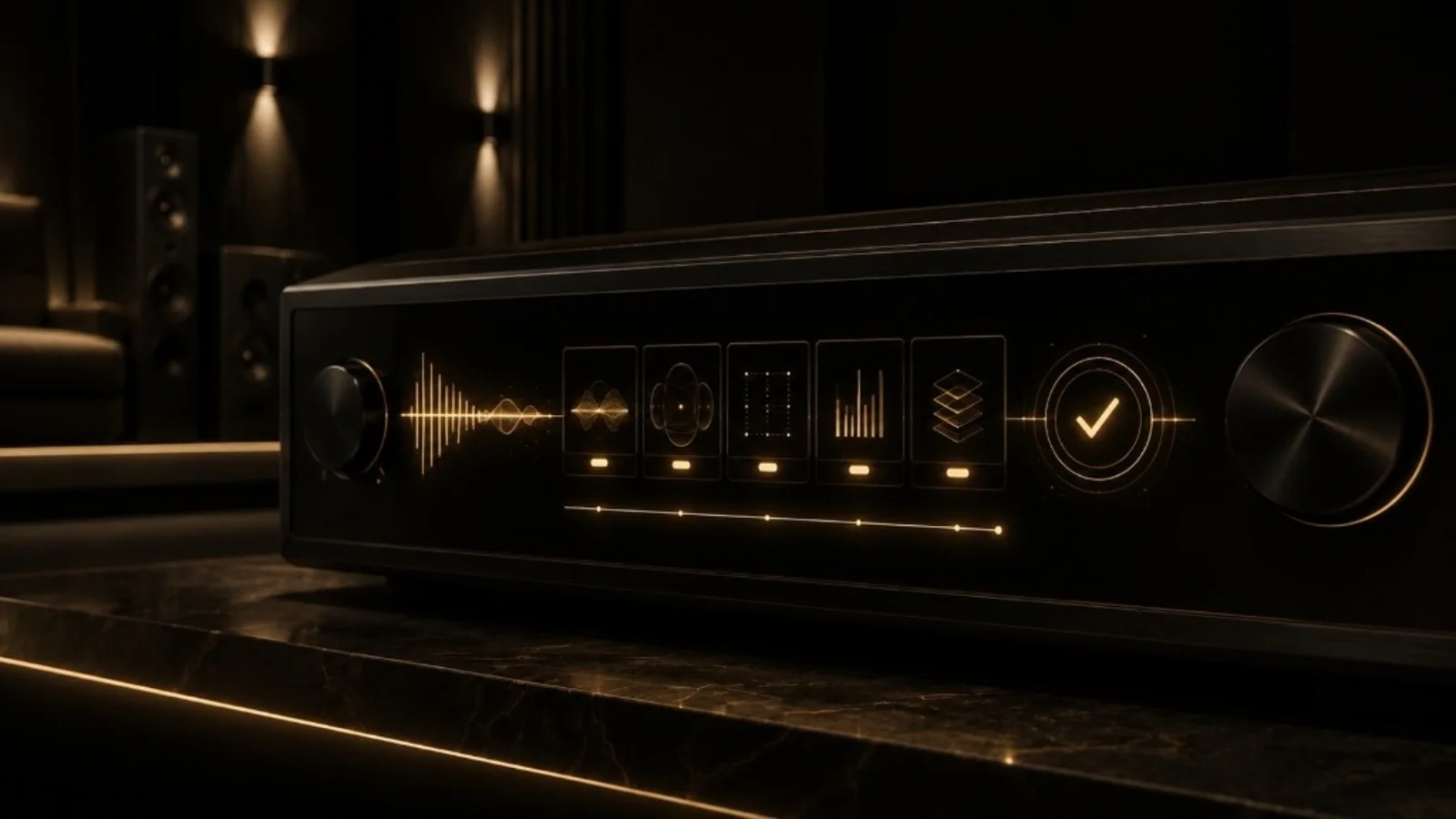

The receiver's front panel is the verdict. These are the kinds of readouts that confirm or contradict the intended path.
Text examples of format readouts, not reproductions of any manufacturer's interface.
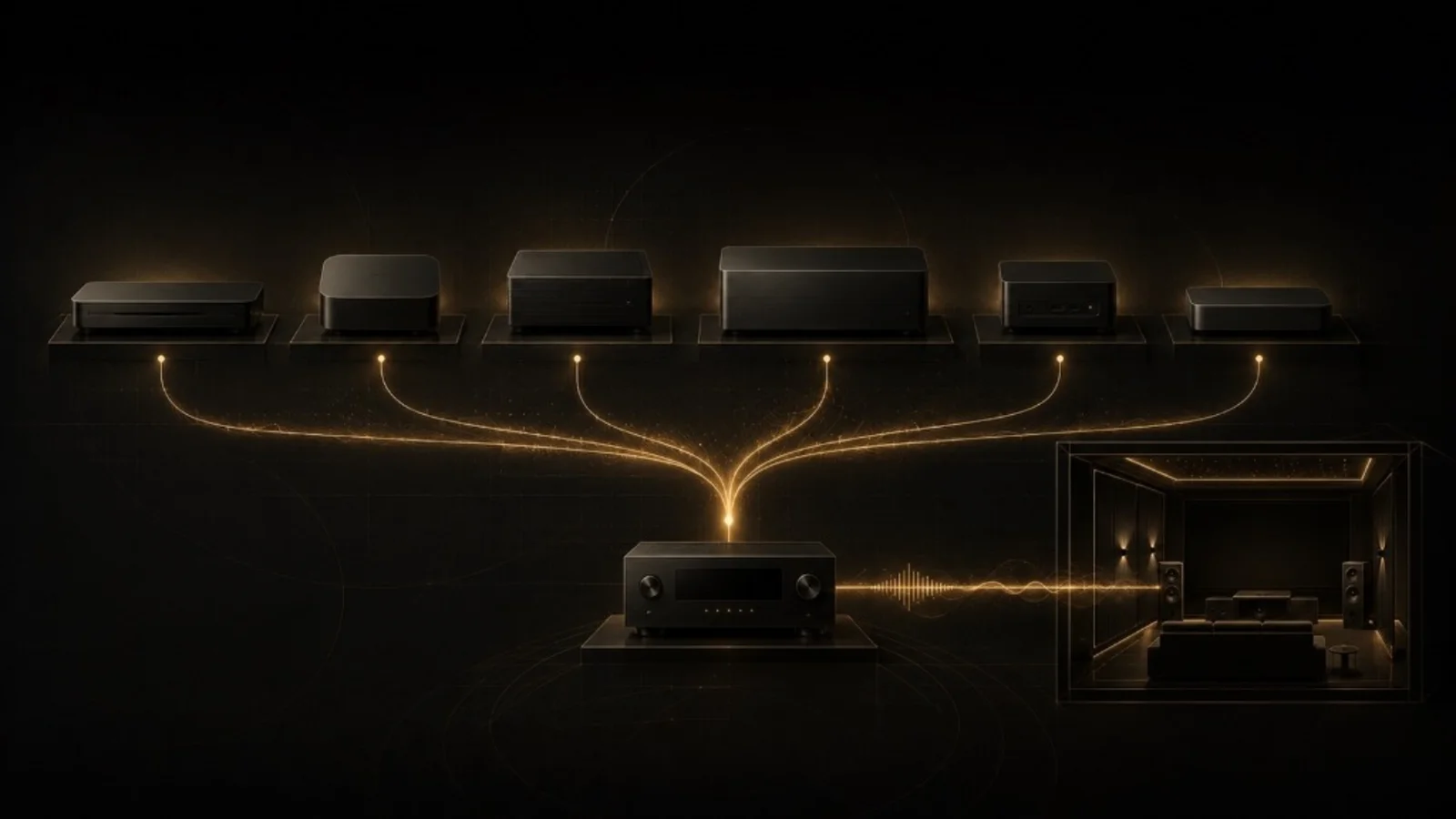
Transcoding happens if the client device does not support lossless passthrough, or if the TV/AVR chain does not properly negotiate eARC. Most built-in TV apps and certain standalone devices do not support TrueHD passthrough, forcing the audio into FLAC or PCM, which permanently removes the Atmos spatial metadata.
To get true lossless Dolby Atmos (TrueHD), you need a playback device that explicitly supports audio passthrough, connected directly to an AVR or soundbar that decodes TrueHD, or routed through a display that reliably handles eARC without internally downmixing the signal.
If TrueHD is Direct Playing but the receiver shows PCM, the playback device is decoding the audio internally instead of passing the bitstream to the AVR. On an Apple TV, this is by design (it uses MAT 2.0). On other platforms, it indicates that passthrough behavior and content audio resolution are not correctly matched to your display hardware.
The exact configuration path varies drastically by room and hardware. Let Cinema Machina map your audio chain to ensure you're hearing the uncompressed spatial audio you paid for.
Looking for reference-grade source material? We also map out the best legal viewing paths across the UAE and India to ensure your setup isn't bottlenecked by low-bitrate streaming.